Word Sort Fun!
Cedar Games StudioWord
4.0520.00 Reviews
- Version
- 1.17.0
- Installs
- 500.00K
- Age Rating
- Everyone
Screenshots
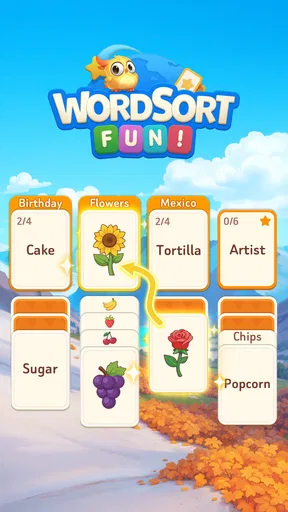
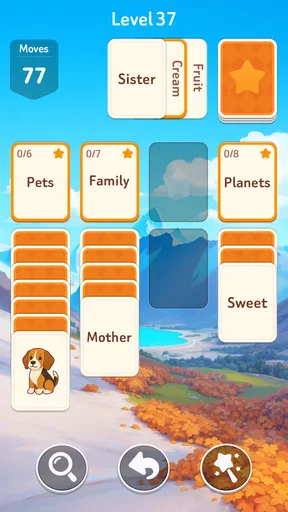

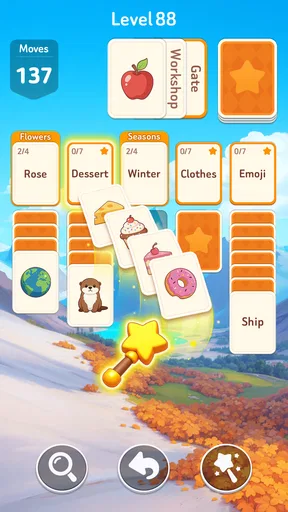
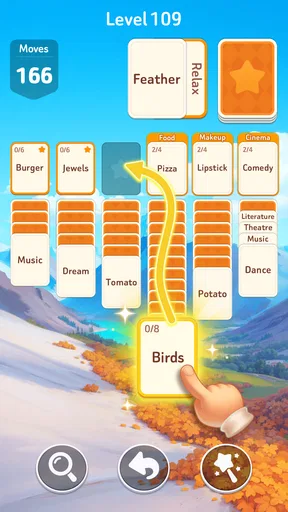
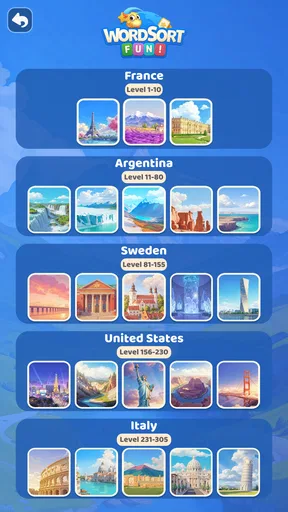
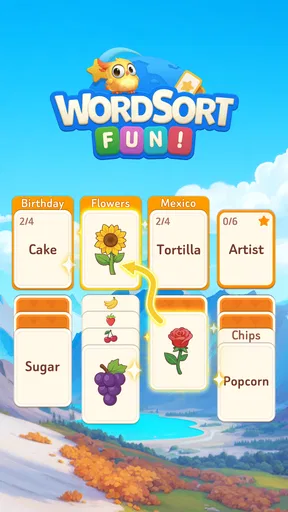
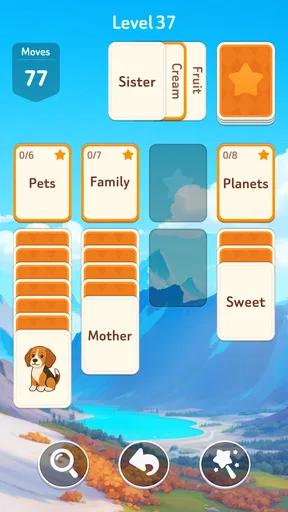
Our Review of Word Sort Fun!
 Analysis by Appyee
Word Sort Fun! is the kind of word game I reach for when I want something calm, simple, and easy to understand without committing to a long session. It is a free puzzle game from Cedar Games Studio, built around sorting and matching words in a solitaire-style format. The basic idea is approachable from the first screen, but the value comes from how carefully you manage each move rather than from fast tapping or complicated rules.
I think its strongest appeal is the low-pressure rhythm. You can open it during a short break, make progress through a puzzle, and stop when you are ready. It is also a reasonable choice for players who enjoy word challenges but do not want a traditional crossword, a timed anagram contest, or a large multiplayer experience. The game is rated for Everyone, so its presentation is accessible to a broad audience, including younger players and adults looking for a quiet mental exercise.
What to expect when you begin
The store summary describes a sorting and matching experience, and that is the right way to approach it. This is not a dictionary lesson disguised as a game, and I would not install it expecting deep story content or elaborate strategy. Its focus is the small satisfaction of recognizing relationships between words, placing them in the right order, and gradually clearing the puzzle.
That simplicity is useful for a first-time player. I did not need to learn a large collection of controls before understanding what the game wanted me to do. The challenge is mainly in seeing the available choices clearly and avoiding a move that leaves the remaining words awkwardly arranged. In other words, the game rewards observation more than speed.
The presentation also makes it suitable for short sessions. A player who likes to solve one compact challenge while waiting for an appointment may find the format more comfortable than a game that demands continuous attention. At the same time, people who need constant novelty, dramatic progression, or competition may find the experience too restrained.
It helps to think of Word Sort Fun! as a casual word-puzzle companion rather than a replacement for every other word game. Compared with a crossword, it appears less dependent on clues and general knowledge. Compared with a word-search game, it asks for more deliberate grouping and arrangement. Compared with a fast anagram app, it gives me more room to examine the board instead of forcing an immediate response.
The game is free to start, which removes the biggest barrier for curious players. It does include optional in-app purchases ranging from $0.99 to $99.99 per item, so I would still advise checking the purchase flow before handing the device to a child. The free entry point is attractive, but the presence of optional spending means the game deserves the same basic attention as any other free-to-play title.
Who will enjoy this format
I would recommend it first to people who like word association, visual organization, and puzzles that can be solved through patient elimination. It can work well for someone who wants a gentle activity before bed, a distraction during a commute, or a small daily habit that does not require learning a complicated system.
It may be especially comfortable for players who become frustrated by countdown timers. A slower puzzle gives me the chance to inspect the remaining choices and reconsider a placement. That does not make every decision easy, but it changes the source of difficulty from pressure to planning.
I would be more cautious about recommending it to players who want a strong vocabulary-building curriculum. Sorting words can encourage recognition and categorization, but it is not automatically the same as teaching definitions, pronunciation, spelling rules, or language structure. Someone studying a language may prefer a dedicated learning app with explanations and review tools.
Getting through the first setup and first puzzle
Word Sort Fun! is available as a free game for Android devices running version 7.0 or later. The current version is 1.17.0, and the developer is Cedar Games Studio. After installing, my advice is to begin without trying to predict the entire puzzle. Look at the complete arrangement first, identify the words that seem most obviously connected, and then make one careful move.
That first inspection matters because the natural temptation is to grab the first pair that looks related. Sometimes that is correct, but a word may also fit a broader group that becomes important later. Treat the opening board as a small planning exercise: notice strong relationships, but keep an eye on words that could plausibly belong in more than one place.
Your first meaningful success should be a deliberate match rather than a random tap. Choose the group whose relationship is clearest, place it, and then pause to see how the remaining options change. This pause is useful because the board becomes easier to read once an obvious distraction has been removed. New players often rush immediately into the next selection and miss the information revealed by the cleared space.
A practical routine is to separate certainty from suspicion. If three words clearly belong together, treat them as a reliable foundation. If two words merely feel similar, leave them alone until another word or the surrounding arrangement gives you more confidence. This approach reduces the chance of using a flexible word too early and discovering that it was needed for a more precise group.
When I play a sorting puzzle, I also scan for category boundaries. Words can feel connected because they share a broad theme, but the intended solution may depend on a narrower relationship. For example, several entries might evoke the same general subject while only some of them form the actual match. The useful question is not simply “What do these words remind me of?” but “What exact relationship do these words share that the others do not?”
This is one of the game’s more interesting trade-offs. The rules are easy to grasp, yet the board can still punish a careless assumption. That makes the opening success reassuring without making the rest automatic. If you make an incorrect choice, do not treat it as evidence that you are bad at word games. Re-read the remaining words and search for the narrower connection you overlooked.
How I handle a confusing board
The most common confusion is usually caused by words that appear to fit more than one possible group. Instead of solving the most attractive-looking relationship immediately, I recommend finding the group with the fewest plausible alternatives. A highly specific connection is safer than a broad one, because it leaves fewer ways for the rest of the puzzle to collapse.
Another useful habit is to avoid building a theory around one unusual word. If a word seems to be the key to everything, test the simpler matches first. Puzzle designers often make the obvious entries useful anchors while leaving a more ambiguous entry for later. Even without knowing the exact construction of a particular board, this mindset keeps the early game manageable.
If you reach a point where every remaining choice looks possible, stop tapping for a moment. I find that a short visual reset is more helpful than repeatedly undoing a guess or moving quickly between options. Read the words from the beginning again, but this time look for differences in type, function, or usage rather than only shared subject matter.
Players may also wonder whether the game is suitable for children. Its Everyone content rating makes it broadly accessible, and the word-based format is less aggressive than many popular mobile genres. Still, suitability depends on the child’s reading level and patience. A young player who enjoys arranging ideas may find it rewarding, while a child who expects constant animation or immediate rewards may lose interest.
A realistic everyday session
Imagine opening the game during a ten-minute coffee break. I would not begin by trying to finish as quickly as possible. I would scan the board, make the clearest match, and use the remaining time to examine the less certain words. If the break ends before the puzzle is complete, the game still served its purpose: it gave me a focused activity that could be paused naturally rather than demanding a full evening.
That same quality makes it useful for winding down after work. A word-sorting puzzle occupies enough attention to interrupt repetitive thoughts, but it does not require the emotional investment of a competitive match. The limitation is that its calming quality depends on how much you enjoy word relationships. If you find ambiguity more irritating than relaxing, a straightforward number puzzle may suit you better.
What becomes clearer after the first success
Once the basic flow feels familiar, the game becomes less about learning controls and more about improving your reading strategy. I would start looking for efficient openings: a match that is not only correct but also makes the rest of the board easier to interpret. That is a more advanced way to play because it values the consequences of a move rather than the move alone.
A strong opening can reduce visual clutter and expose the words that were previously competing for attention. This gives the game a modest layer of planning that is easy to miss when playing casually. The best decision is not always the group that looks most satisfying; sometimes it is the group that removes the most uncertainty from what remains.
Another useful technique is to mentally rank possible groups by confidence. I might label one relationship as nearly certain, another as likely, and a third as merely possible. I then play from the top of that internal list. This prevents a tempting but weak idea from taking control of the whole puzzle.
For players who want to make the game part of a routine, I suggest keeping sessions short at first. The format is well suited to regular play, but repeating the same kind of puzzle for too long can make every word start to look interchangeable. A short session preserves attention and makes it easier to notice whether you are enjoying the challenge or simply tapping out of habit.
The game’s average rating is 4.1 from around 4.3 thousand ratings, with over 500 thousand installs. Those figures suggest that it has reached a substantial casual audience, while the rating also feels consistent with a focused game that will appeal strongly to some players and less so to others. I would not interpret its popularity as proof that it fits everyone; the central question is whether sorting and matching words sounds enjoyable to you.
Its free price is another reason to try it rather than speculate. You can see whether the pace, word choices, and puzzle structure suit your habits before deciding whether optional purchases have any value for you. I would avoid buying anything immediately. First learn how often you play, whether you can make satisfying progress without spending, and whether the game remains enjoyable after the novelty of the first session fades.
Where it differs from familiar alternatives
Traditional solitaire games usually revolve around numbered cards and predictable suits, while this game brings a language-based decision into the same general casual-puzzle space. That makes it more mentally interpretive than a purely visual matching game. A player who likes arranging cards but wants more meaning in each choice may appreciate the change.
Crossword players may enjoy the vocabulary element but should expect a different kind of thinking. Crosswords often reward recalling a specific answer from a clue and fitting it into a grid. Here, the challenge is more about recognizing relationships among visible words. If you prefer clues, definitions, and a finished grid, a crossword app may offer greater depth. If you prefer grouping and eliminating possibilities, this game is likely the better match.
Word-search games are often relaxing because the target words are already known and the task is visual discovery. Word Sort Fun! asks me to interpret the entries before I can confidently place them. That creates more uncertainty, but also makes a correct group feel more earned. The trade-off is that a difficult board can feel subjective when the connection is not immediately obvious.
Fast word games remain the better choice for players who want pressure, leaderboards, or rapid vocabulary recall. This title appears designed around a calmer pace, so it is not the one I would choose for a competitive party or a timed personal challenge. Its strength is concentration without urgency, not adrenaline.
Things to consider before installing
The first limitation is the narrowness of its central idea. Sorting and matching can be satisfying, but it cannot provide the variety of a large collection of unrelated genres. If you need stories, character progression, action, or social play, this will feel too focused.
The second is the possibility of ambiguity. A word-based puzzle can be harder to judge than a number puzzle because language carries associations and shades of meaning. When a grouping feels unclear, the frustration may come less from difficulty and more from uncertainty about the intended relationship. That is part of the appeal for some players, but a genuine drawback for others.
The third is the free-to-play context. Optional purchases between $0.99 and $99.99 per item create a wide spending range. I would keep purchase controls protected on a shared device and treat any paid option as something to evaluate after regular use, not as a requirement for the first successful puzzle.
Privacy and device comfort are also worth considering in practical terms. I would install it on a supported device, check that the game feels readable on the screen, and make sure the player using it is comfortable with the amount of text. A word game depends heavily on legibility; even a well-designed puzzle becomes tiring if the entries are difficult to distinguish.
My recommendation after spending time with it
Word Sort Fun! succeeds when I want a small, thoughtful activity with rules I can understand quickly. Its strongest moment is the transition from uncertainty to recognition: I notice a precise relationship, make the match, and suddenly the remaining board becomes easier to read. That feeling is modest, but it is exactly what a good casual word puzzle should provide.
For a first-time user, the best path is simple: install the free game on a compatible Android device, inspect the opening board, make the most certain match, and wait to see what that decision reveals. Do not rush ambiguous words, and do not assume that the broadest shared theme is automatically the intended answer. Those two habits make the early experience much less confusing.
I would recommend it to adults and families looking for a quiet word challenge, especially those who enjoy puzzles that can fit around ordinary routines. I would skip it in favor of a crossword, language-learning tool, or competitive word game if your priority is instruction, clue solving, or speed. The game is not trying to be all of those things, and it is better judged on its own focused terms.
Cedar Games Studio has kept the concept approachable enough for a casual audience while leaving room for careful players to improve their decision-making. The current version, 1.17.0, gives prospective players a clear starting point, and the Everyone rating makes the game broadly accessible. My final view is positive but specific: this is a good choice when you want word sorting that rewards patience more than reflexes, provided you are comfortable with occasional ambiguity and the optional purchase model.
If that description matches the kind of break you want from your phone, I think it is worth trying without overthinking the commitment. Give the first few puzzles your full attention, learn which relationships feel natural to you, and then decide whether the game deserves a regular place on your device. For me, its appeal is not spectacle; it is the quiet satisfaction of turning a messy group of words into an orderly solution.
Verdict
Strengths of Word Sort Fun!
- Simple rules make it easy to start playing immediately.
- Short levels are convenient for quick breaks or casual sessions.
- Word categories help reinforce vocabulary and spelling skills.
- Bright visuals and animations make the experience feel lively.
- Suitable for players who prefer relaxed, non-action gameplay.
Limitations of Word Sort Fun!
- Some puzzles may feel repetitive after extended play.
- Difficulty can vary noticeably between different levels.
- Hints or extra moves may be limited without watching ads.
- Ads can interrupt the flow, especially between completed levels.
- Players seeking advanced word challenges may find it too simple.
Other Releases by Cedar Games Studio
View All
Tile Clear - Puzzle Game
Puzzle4.9

Mystery Town: Merge Games
Puzzle4.8
Similar Picks in This Category
View All
Word Search - Word Puzzle Game
Bluetile4.8

Word Search Quest - Puzzles
Blackout Lab4.8

CodyCross: Crossword Puzzles
Fanatee, Inc.4.7

Words of Wonders: Crossword
Fugo Games4.9

Wordscapes: Word puzzle game
PeopleFun4.7

Word Search Explorer
PlaySimple Games4.9
Frequently Asked Questions
What is Word Sort Fun!?
Word Sort Fun! is a casual word puzzle game focused on organizing, matching, and sorting letters or word groups to complete each level. Its simple gameplay makes it easy to start, while progressively more challenging puzzles test vocabulary, spelling, concentration, and pattern recognition. It is designed for short sessions, so you can play casually or spend longer periods solving puzzles.
How do you play Word Sort Fun!?
The main objective is to examine the letters, words, or categories shown on the screen and place them in the correct order or group. You generally tap, drag, or rearrange items according to the instructions provided in each puzzle. Early levels work as a tutorial, but later challenges require more careful thinking, planning, and sometimes trial and error to find the correct solution.
Is Word Sort Fun! suitable for children and beginners?
The game is generally approachable for beginners because its controls are straightforward and the early puzzles introduce the gameplay gradually. It can also be suitable for children who enjoy vocabulary and logic games, although the difficulty and word choices may vary between levels. Parents should review the available content and device settings, especially if the app includes advertisements or optional purchases.
Does Word Sort Fun! require an internet connection?
Some parts of Word Sort Fun! may work without a constant internet connection, which is convenient for playing during travel or when mobile data is unavailable. However, features such as advertisements, progress synchronization, updates, special events, or in-app purchases may require access to the internet. Because offline availability can depend on the version and device, it is best to test the game after installation.
Is Word Sort Fun! free to download, and does it contain ads or in-app purchases?
Word Sort Fun! may be available as a free download, but free access commonly includes advertising and optional in-app purchases. These purchases can potentially provide hints, remove ads, unlock content, or offer other gameplay advantages, depending on the version. Before downloading, check the official store listing for the current pricing, age rating, permissions, subscription details, and purchase information.
Play our best games!


